Beyond Identity: What Happens When You Stop Defending Who You Are
We build an identity to survive. It provides us a sense of who we are, what we believe, how the world works. It gives us a certainty of perspective and self, a stable platform from which to navigate a complex, destabilising world. Identity becomes a safe space we have created within ourselves. It tells us what to expect, how to respond, what is ours and what is not.
And it works- up to a point.
The trouble is that identity is not just a description of who we are. It is a defence. A structure built around our wounds, our fears, our early experiences of what the world demanded of us. It hardens over time, and as it hardens, it narrows. We stop responding to life as it is and start reacting from a fixed position. We defend our perspective rather than update it. We protect our sense of self rather than allow it to evolve.
Most of us don't notice this happening, because the self is a persistent, self-reinforcing system. It mediates, assimilates, and integrates every experience into this persistent sense of who we are, and it remains constant. New experiences are filtered through existing beliefs. Challenges to our worldview are deflected or rationalised.
Even therapy, when it works within the framework of identity, tends to adjust the system rather than transform it. We might understand ourselves better, unburden some of the weight, but the fundamental structure stays intact.
The cost of certainty
Identity provides a reassuring sense of certainty. But certainty comes at a cost.
When we are very identified, very certain of who we are, the world divides neatly into what fits and what threatens. We harden against what doesn't fit. We react when things don't go the way we would like. We build our lives around maintaining stability, and call that stability happiness, even when it feels more like endurance.
And because the self-reinforcing system is so effective at maintaining itself, we can spend years, decades, feeling stuck without understanding why. The patterns that once protected us have become the walls that contain us.
What lies beneath identity
In my bodywork practice, I guide my clients into a deeply meditative, somatic experience. The thinking mind quiets, the usual commentary and self-narration falls away, and what remains is awareness without the usual filters of identity, judgement, and self-protection. The client is present, conscious, but experiencing from a place beneath the self.
For some people, especially those with a strong sense of identity, this can feel unsettling at first. Without that familiar certainty, every experience is a step into the unknown. There is no inner narrator to categorise and explain what is happening. There is just sensation, breath, and presence.
Many people have never had an experience that isn't mediated by the mind. Perhaps an inner monologue that narrates and comments on everything they do. When that monologue goes quiet, and the secure sense of certainty is not there, the ground can feel unfamiliar. And yet, clients feel safe throughout the session. The experience, far from being frightening, can feel liberating in a way they did not know was possible.
The discontinuity
This is where the transformational potential lies.
Usually, the self mediates every experience. It assimilates and integrates what happens to us into a consistent story. Change within this system is incremental, because the system itself is doing the processing. It’s like trying to renovate a house while living in it.
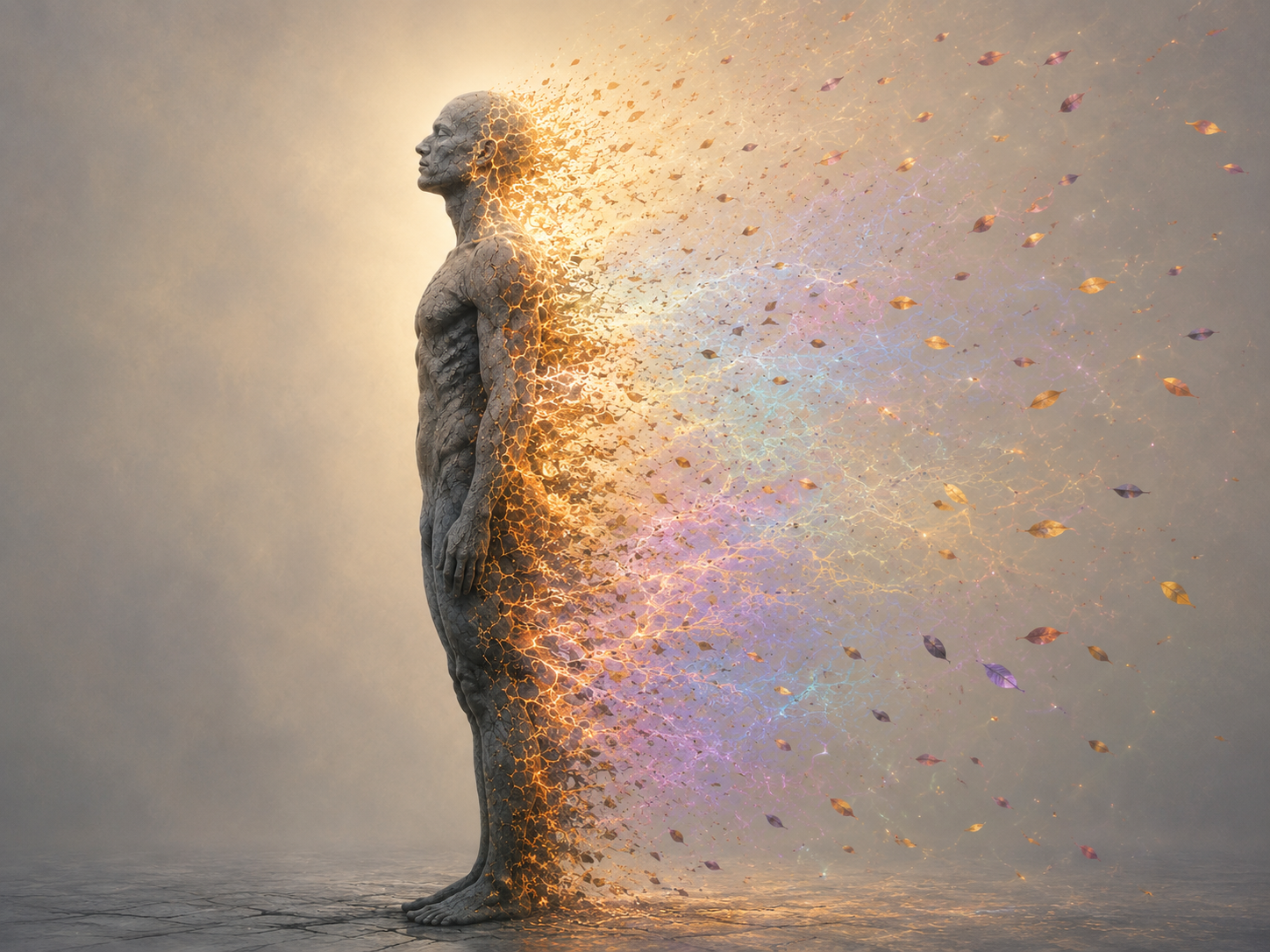
By working beneath identity, in the somatic experience where ego and its protections have stepped aside, change can occur on a deep level that is not filtered through the persistent sense of self. I call this a temporary discontinuity. Not dissociation, the client is aware throughout, but a space in which the usual self-reinforcing system is not running the show.
Two things happen in this space.
First, the experience of selflessness shows the client that being can be more expansive than fixed identity permits. There is more to them than the story they have been telling.
Second, the felt difference between before and after the session, a change that was not mediated by the self, can start to shift their sense of who they are. There is a continuity of awareness throughout, but they feel a transformational difference from how they felt before.
This is not something that can be achieved by thinking about it. It is experienced. And because it is experienced, it integrates in a way that concepts and insights cannot.
What opens up
As the body becomes a safer space to inhabit, something interesting happens: the need for self-certain identity diminishes. Not because identity is destroyed or abandoned, but because it is no longer the only ground to stand on. The body provides its own ground: felt, immediate, alive.
From this embodied place, we become more adaptive, more intuitive, more able to flow with life's turmoil rather than defend ourselves against it and react when things don't go the way we would like. We gain an extra sense that helps us get a feel for a situation. The body becomes a source of wisdom that can provide answers to the questions we might ask.
Attachment to personal identity naturally softens. The fixed idea of who we are loosens, and we realise our potential to be more expansive than fixed identity permits. This is a process that continues long after the session, and continues to unfold over a lifetime.
Once we step out of identity and into embodied being, the world becomes a place of potential and possibility, rather than something we have to harden against in order to survive. We don't lose ourselves. We find that there is more of us than we knew.
If you'd like to explore whether this approach might work for you, I would be happy to listen and see if I can help.