What Is Fascia, and Does It Hold Your Trauma?
Most people come to me because of some persistent issue that they cannot shift. It may be persistent discomfort, tension in the muscles, a body or emotion that feels stuck, an inability to switch off or relax, a tightness that won't shift no matter how many massages they get. And almost everyone is surprised when I tell them we are going to be working with their fascia, not their muscles.
So what is fascia, and why does it matter?
The web that holds you together
Fascia is a continuous web of connective tissue that runs through your entire body. It surrounds and connects every muscle, bone, organ, and nerve. Think of it less as separate pieces and more as one unbroken fabric: if you pull on it in one place, the tension travels. A restriction in your hip can show up as pain in your shoulder. A tightened jaw can be connected to tension in your pelvis.
Unlike muscles, which contract and release in response to immediate signals, fascia adapts slowly over time. It thickens, hardens, and restructures itself around patterns of use, injury, and stress. These adaptations are the body's way of protecting you. They minimise pain signals, redistribute load around an injury, and create stability where the body feels unsafe.
The problem is that these adaptations persist long after the original injury or stress has passed. They become the architecture of persistent tension and associated pain.
Beyond the physical
Here is where it gets interesting, and where fascia work departs from conventional massage.
Fascia does not only adapt around physical injuries. It responds to emotional and psychological experience too. When we experience something overwhelming, something the mind cannot process in the moment, the body responds. Muscles tighten. Breathing restricts. The tissue around the emotional wound hardens, creating what is sometimes called "body armouring": a physical barrier that protects us from feeling the full intensity of what happened.
This armouring can be:
Physical, restructuring around an injury to protect the area
Emotional, tightening to shut down feelings around grief, rage, fear, or shame
Psychological, creating numbness or disconnection when sensation feels too overwhelming
Generational, patterns inherited and anchored in bodily tension before we even have words for them
I see this in every session, and every client experiences it differently. I have worked with a client whose physical tension held a deep emotional wound. As the tensions softened and the client felt safe, the emotions flooded out. Pain and emotional wounds can feel permanent because we cannot fully release them, and they have been with us for so long. Yet when supported to release in this way, it can be truly cathartic, a relief, and long-lasting. What felt permanent has gone, in a way we did not believe possible.
Another client, as I worked through the quads, experienced release as laughter, carefully managed so she could stay present and feel safe, so the release was pleasurable rather than re-traumatising. This was a lifetime of repressed joy, and the change affected her entire way of being: feeling more light and playful in her daily life. Another, working through her hamstrings into her glutes, felt the energy of anger that had been stagnant and stuck start to move and release.
Every client experience is different. Every client is unique and requires an approach tailored to them personally.
But the underlying process is the same: fascial tension holds emotional energy, and when the body feels safe enough to let go, it does.
Why talking about it isn't enough
This is the key point. If trauma and emotional wounding are held in the physical structure of the body, then addressing them only through the mind, through talking, analysing, and reframing, leaves the body untouched. The pattern of tension remains. The armouring stays in place. And so the experience of being in your body doesn't change, even if your understanding of your history does.
This is why some people can spend years in therapy, gain real insight into their patterns, and still feel stuck. The insight is genuine. But the body hasn't caught up.
What changes when the fascia releases
When fascial restrictions soften and release, the change is tangible. Clients describe feeling more spacious in their body, more grounded, lighter. Discomfort that has been persistent for years, even ones that we came to believe were permanent, can finally start to ease. But often the deeper shift is phenomenal and emotional: a sense of coming home to the body, of the body becoming a safer place to inhabit.
That is the difference. Conventional massage addresses muscular tension and it feels good. Fascia work addresses the deeper structural patterns, the ones holding patterns of dysfunction, trauma, and emotional history in place, and can help the body let go of what it no longer needs to carry.
You are present throughout
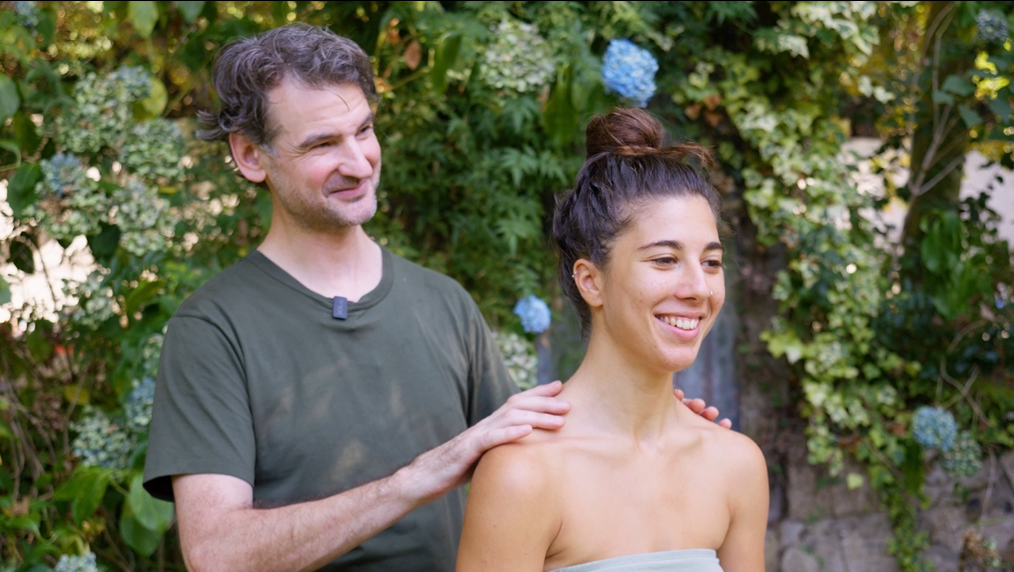
An important distinction in my approach: this is not myofascial release that is done to you. The process is co-participatory; the client is deeply immersed, but fully present throughout, a witness and observer to change as it happens. You experience the release within yourself.
This juxtaposition, being present throughout and yet feeling very different before and after, is part of the transformational process at work. Attachment to personal identity naturally softens, the fixed idea of who we are, and we realise our potential to be more expansive than fixed identity permits. This is a process that continues long after the session, and continues to unfold over a lifetime.
If you'd like to explore whether this approach might work for you, I would be happy to listen and see if I can help.