Bottom-Up, Not Top-Down: A Different Approach to Emotional Healing.
Important note: My post excludes medically-necessary talk-based therapy for serious psychological conditions. For these conditions, you should seek medical advice from a medical practitioner. Transformational Bodywork is not a treatment for any medical conditions.
If you have tried counselling before, chances are it was top-down, talk-therapy: a conversation, an exploration of your thoughts, beliefs, memories, and the stories you tell yourself about who you are and why. You work from the mind downward, trying to understand and reframe your experience so that it no longer controls you.
This is valuable work, and for many people it is transformative. But for some, it isn't enough. They understand their patterns. They can name their wounds. And yet something in the body remains unchanged.
Transformational Bodywork takes the opposite approach. It is bottom-up: starting at the level of bodily sensation, rather than thought, and working from there.
What "top-down" actually means
Many therapeutic approaches, whether traditional psychotherapy, CBT, hypnotherapy, or even rapid modalities like Rapid Transformational Therapy (RTT), work through the mind. They access painful memories, reframe the meaning attached to them, and help you build new thought patterns. RTT, for example, uses hypnosis to access the subconscious, uncover when and why an issue originated, and then reprogram the response through repeated listening to personalised recordings.
These are sophisticated approaches, and I have respect for them. The question is not whether they work, but where they work. They operate within what I think of as a self-reinforcing system: the triangle between your thoughts and emotions, your bodily sensations, and your actions and habits. These three domains reinforce each other constantly, creating stable patterns that feel like identity. Top-down therapy works within this system, adjusting the mental and emotional components and hoping the body and behaviour follow.
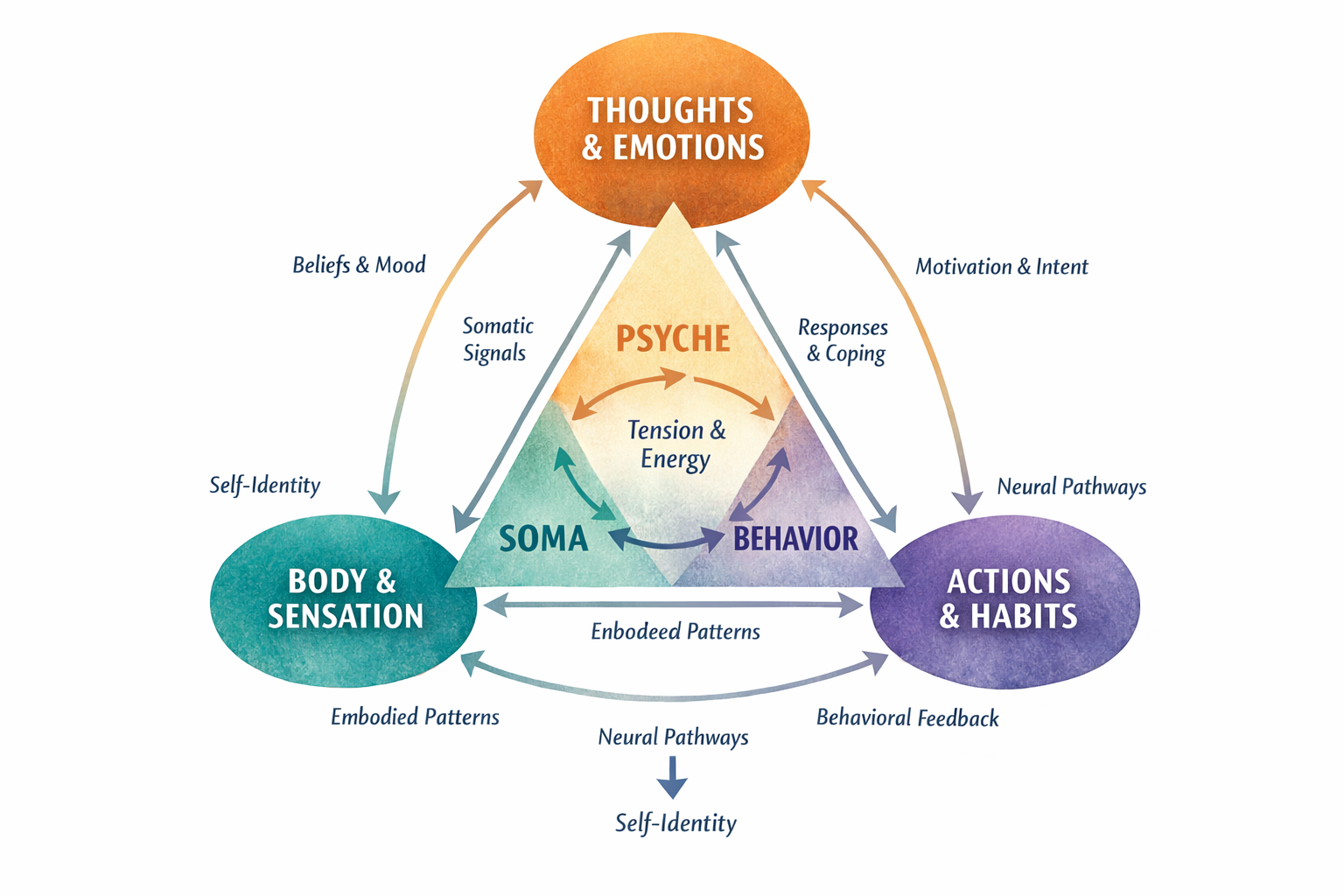
The self-reinforcing system of psyche - soma - behaviour, or thinking, feeling and action. Transformational Bodywork aims to help you step out of this system, to observe more objectively, and observation without identifying and without reaction, can create change within this system.
Whilst this works for some people, for many others it does not. Perhaps the mind won't let them go there. Perhaps they need something that goes deeper, something that isn't mediated or accessible by the mind.
What "bottom-up" means
A bottom-up approach starts at the foundation: the sensations in the body. Not the story about the sensation. Not the memory attached to it. The sensation itself.
In a session, I use gentle breathing exercises and slow, conscious touch to guide the client's awareness out of the thinking mind and into the body. As they settle deeper into this somatic experience, a kind of meditative state arises naturally: present, aware, but without the usual running commentary. From this place, the client can observe tensions and discomfort without reacting to them, without the usual flinch or avoidance or narrative that keeps the pattern in place.

And when you observe sensation without reaction, something remarkable happens. The tension begins to change. Solidity softens. What was static becomes fluid. Patterns that have been held for years, sometimes decades, start to dissolve. The client watches this happen in their own body, in real time.
They are not told about it afterwards or given it as a concept to believe in. They experience it.
Why the distinction matters
The difference is not just technical. It is about what kind of change becomes possible.
Top-down approaches, even the best ones, maintain continuity of self throughout the process. You are the same person before and after the session, with a new understanding of your experience. This is unburdening, and it is real, valuable work.
What I facilitate is something different: a temporary discontinuity. A space in which the ego, the protective mechanisms, the defences, and the trauma-based resistance to change are not overcome or worked through but simply bypassed. The client enters a state of awareness beneath identity, where patterns held in the body can release without the usual fight.
This is why I call it transformational. Not because the word sounds impressive, but because the change happens at a level deeper than understanding. You do not just think about yourself differently afterwards. You experience yourself differently. The body becomes a safer, more spacious place to inhabit.
This is not a competition
I want to be clear: bottom-up and top-down are not rivals. They address different layers of experience. Some people need one, some need the other, many benefit from both. I have worked with clients who made real progress in talk therapy and then found that bodywork released what remained. I have also worked with people for whom talking about their experience was re-traumatising, and the body offered a way in that words could not.
One client came to me feeling persistently tense and unsettled. She had tried talk-based counselling and even body-based therapy, but struggled with extreme sensitivity to touch. She could not find clarity, nor tolerate touch without reaction: tickling and laughter that never touched very deep and couldn't be tolerated for very long. By helping her ground, focus first on breathing, then on bodily sensations, she could then be present with touch, and start to observe sensations. By this approach, she could stay present in the experience of sensations; she reported feeling safe, and her breath naturally took on a more expressive character. For the next two hours, we could work very deeply to help her nervous system settle, using sensitive yet firm pressure and her breathing to help release the emotional charge she carried, and working with the deeper tensions that cause the accumulation of energy as tension in the limbs, which resulted in the discomfort, oversensitisation and heightened state that was her experience. Afterwards, she reported feeling much more spacious, lighter and more settled.
Another client came to me for a session without any specific complaint. During the consultation, she mentioned that she had questions about motherhood that she couldn't find answers to. I gave a deep, relaxing massage, working to release tensions and allowing accumulated energy to move. During the assessment of tensions that I map in every first session, I noted fascial adhesions in the upper chest area. After reporting, asking consent, I worked to release granular adhesions in the pectorals, through the chest and under the breast tissue. By the end of the session, the client reported feeling more open, less confused, more settled in herself, and that she had found an answer to her question. By embodying the question, being present, letting go all sources of disturbance, and deep immersion in the somatic experience, rather than being stuck in the mind, she created space for her intuition to speak; to answer questions that the mind could not resolve by thinking on it alone. By working to embody more deeply, it can help us to become more aware of what we feel, and what the body is trying to say, and understand what those feelings are trying to tell us.
If you have done good work in therapy and still feel that something is held in your body that thinking cannot reach, a somatically-based bodywork approach might be what you are looking for.
If you'd like to explore whether this approach might work for you, I would be happy to listen and see if I can help.