Where Your Body Holds What Your Mind Won't Say
We are conditioned to live from the neck up; the mind and our identity become a safe space for us to operate in a chaotic world.
We learn to think our way through problems, to talk about our feelings, to understand ourselves through narrative and analysis. And so when the body speaks, through pain, tension, tightness, numbness, or that heavy feeling we can't quite name, we either ignore it, medicate it, or explain it away as stress.
Over fifteen years of experience of trauma-process work and body-based modalities, I have found that different areas tend to hold different kinds of emotional experience. There are common patterns and maps that guide practitioners in understanding what the body may be communicating. The throat, for example, often holds tension around self-expression: people who have learned to swallow their words, who were not allowed to speak their truth or never felt safe to. The shoulders carry burdens and responsibility, the weight of carrying more than is ours to carry. The heart centre tends to hold grief, sorrow, loss, the ache of not being loved or not being able to love. And the solar plexus holds fear: anxiety, the need for control, the dread of losing it.
These patterns are a guide, not a prescription. When I work with a client, it is intuition formed from experience that guides me, and dialogue that reveals the associations that particular sensations hold for you. It may be a memory, an emotion, a story.
Because we are both present with sensation, this is all accessed without the reaction that the memory alone might have triggered.
How this works in practice
My intuitive sense and prompting can help you find these associations, but the revelation all comes from you. Alongside the safety and guidance I provide, this is what makes the work therapeutic rather than re-traumatising. The trauma, the underlying sensations, and the system of associations, the memories, feelings and behaviours that reinforce each other, can be processed as a whole, rather than adjusted sequentially or by parts.
By accessing the sensations at their source, the associations may be revealed to you and you can free yourself from them. By being guided to observe without reaction, and experiencing as the intensity of the underlying sensations weakens and dissolves, what felt permanent starts to change.
I have felt a person's chest soften under my hands as decades of held grief came to the surface. I have worked along a line of tension in someone's side and felt the moment it gave way, and watched their face change as something they had been carrying arose, was felt, and passed through. Something that the client had felt for a long time, that the client could not let go of, and the body had held onto, started to feel like a permanent fact, which the mind believes will never change. This becomes a limiting belief. When bodywork releases the fascial armour that has formed, when the client feels safe and supported, and when emotion start to move, it came as a genuine surprise to the client.
On the Camino de Santiago pilgrimage, I met a man struggling to walk without pain. I spent an hour working on a solid fascial ridge along the top of his foot, felt it soften, and worked in through the ankle. I told him he would probably feel very emotional, and then it should be less painful. He messaged me the next day: he told me he had felt very emotional in the evening, but woke up and was now walking without pain. He couldn't believe it. When fascia sticks and solidifies, it creates strain elsewhere in the system, which can lead to inflammation and pain where the system is weakest, often far from where the fascia is restricted. Releasing the fascia reduced the strain in the system, removing the cause of the painful inflammation.
Another traveller had been struggling to walk every day of the journey. In a short session, I brought his awareness to the sensations in this body, to scan further the source of pain, to palpate and find the tensions formed around that pain, to practice observing sensations without reaction, and then applying my sports massage training to work the tensions as he observed. Although we worked only one short session, he now had awareness of the tensions held in the fascia, he had learned to observe it without reaction, and learned the tools to continue to release it by working by himself. He reported that he continued his self-observations and self-practice every day, and in the final stretch of the Camino, he walked the final fifty kilometres in a single day without pain.
There is nothing magical about how fascial tension can result in persistent pain, and how fascia release can bring relief. Normal usage and stretching work the muscles, but do not affect the fascia. We can feel like we’ve tried everything, stretching, strengthening, and because nothing we tried worked, we can end up believing that it is a permanent fact we must endure. Once the fascia becomes stuck, action and stretching can put strain on the parts that are already loose; the muscle tissues, tensions, ligaments and joints. Repetition can cause tears and inflammation, which cause pain with every use, and cause the problem to persist. The pain and a reluctance to further aggravate can result in less activity and mobilisation, which can cause further fascial tightening. This can lead us to believe that the condition is degenerative. When we release the fascia, it takes strain off the tissues that are already inflamed, which means that they can then start to heal.
Without awareness of the issue, our actions continued to aggravate and cause us pain, which then reinforces the dysfunction. When we bring presence to what is there, to the tensions held in the fascia, and observe without reaction, then the tensions can start to release. We can start to address the source of the problem, rather than treat the area of pain, and we can break the cycle of self-reinforcement.
Learning to listen
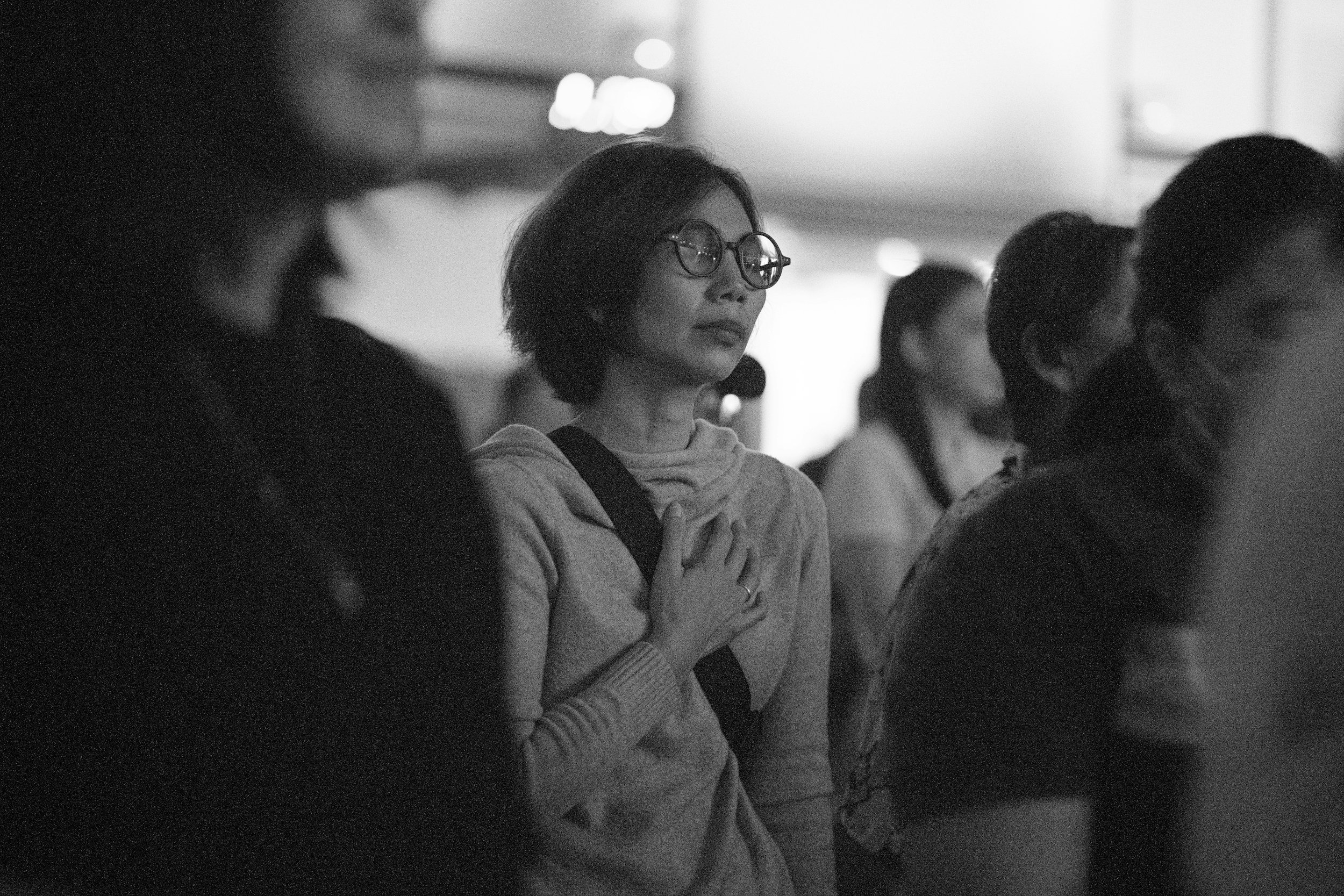
This is perhaps the most important shift my work offers: helping people learn to listen to their own body. Not as an object to be fixed or managed, but as a source of intelligence that has been communicating all along.
Most of us have spent so long ignoring or overriding the body's signals that we have lost the ability to hear them. Pain becomes background noise. Tension becomes "just how I am." Emotional numbness becomes a way of life. The body adapts, hardens, shuts down, and eventually, we forget there was ever anything else.
In a session, as the breath deepens and the awareness moves from the thinking mind into the felt sense of the body, that forgetting starts to reverse. Sensations that were muted start to become vivid. Tensions that were invisible become tangible. And as they are met with awareness rather than resistance, they begin to change.
The body becomes a safe place to inhabit again. And when we learn to live from that embodied space, we gain something more: an extra sense that helps us get a feel for a situation, and a source of wisdom that can provide answers to the questions that we might ask. What might your body be communicating to you?
Presence, somatic experiencing, and bodywork approaches to de-armouring can release the fascia, which can have a restorative effect, and change seemingly permanent beliefs about the permanence of your present experience and the inevitability of further degeneration.
If you'd like to explore whether this approach might work for you, I would be happy to listen and see if I can help.
Disclaimer: These are personal anecdotes of real experiences and reports from individuals. I have personal experience of the effectiveness of my work, but each treatment is client-specific, as are the results. I do not claim to offer general treatments for conditions or offer any guarantee of results.