What is Transformational Bodywork?
In short, a somatic massage therapy to release embodied trauma, reframe your relationship with body sensations and feel at home in your body. For you, it will be a deeply meditative process; a safe, deeply relaxing, immersion from mind into somatic experience, an egoless state of presence that feels timeless, and yet present throughout as you observe tensions and old holding patterns release, and energy move in the body. The sessions are held with presence, safety and wisdom that comes of many years of exploration and practice to help guide you through and understand whatever may arise.
How I work
I help you immerse into the somatic experience, an egoless state of presence and bodily observation. I help guide your awareness to bodily tensions without triggering pain. As you observe without reaction, and with conscious touch, long-held tensions simply soften and release, stuck emotions (fear, pain, anger and/or joy) are released, and seemingly permanent pain dissolves and disappears.
For permanent results, I help release association tensions locally around areas of trauma and dysfunction, allowing energy stored to be discharged, and helping you through any emotional release. This integrated work brings long-lasting benefits, restoring a new stable state, a more functional structure in the fascia, and helping restore more natural function over time.
In deeper sessions, I release patterns of tensions through the whole body system, which helps release deeply-ingrained and identified trauma, and allows healing to occur. Deeply held aspects of psychology and identity can change during such sessions. It can help you feel more connected, more integrated, more whole, more fully alive. The changes you feel on the inside with be reflected in
When you re-emerge out of the immersive experience, trauma that had become part of your identity might simply be gone. You experience yourself, but differently, and can integrate the change because you were present throughout the process. Afterwards, I can answer questions about your experience in the session and provide explanation to help your mind understand the experience, which helps to anchor and integrate transformative change.
This is how this bodywork can be transformational.
What is Fascia?
Fascia is a continuous, body-wide web of connective tissue that holds together and integrates the seemingly disconnected body parts and structures.
Fascia holds the body together, providing form and structure to support the body, helps transmit force, absorb shock, and organise movement. It also contains nerves that connect through the whole body that facilitate communication between different structures and systems.
Fascia holds the patterns of adaptations that form in response to injury, trauma and dysfunction, including tensions, maladaptations, and adhesions, which help minimise stress and/or pain signals around areas of trauma. This trauma can be physical, emotional, psychological or generational in origin, but is anchored in the patterns of tensions in the body. For example, this can be restructuring around injury as functional adaptation to injured tissue (physical), or a tightening and hardening of fascia to shut down feeling around emotional wounds (emotional), or dissociation when the body sensations feel too overwhelming and the body no longer feels safe (psychological).
Tensions held within the fascia can be a source of chronic pain, embodied trauma, emotional-behavioural patterns, physical dysfunction, and postural misalignment. This bodywork therapy can address all these sources of trauma held in the body.
How does Transformational Bodywork help?
I help you immerse into the somatic experience, an egoless state of presence and bodily observation. I help guide your awareness to bodily tensions without triggering pain. As you observe without reaction, and with conscious touch, long-held tensions simply soften and release, stuck emotions, (fear, pain, anger and/or joy) are released, and seemingly permanent pain dissolves and disappears.
For permanent results, I help release association tensions locally around areas of trauma and dysfunction, allowing energy stored to be discharged, and helping you through any emotional release. This integrated work brings long-lasting benefits, restoring a new stable state, a more functional structure in the fascia, and helping restore more natural function over time.
In deeper sessions, I release patterns of tensions through the whole body system, which helps release deeply-ingrained and identified trauma, and allows healing to occur. Deeply held aspects of psychology and identity can change during such sessions. It can help you feel more connected, more integrated, more whole, more fully alive.
When you re-emerge from the immersive experience, aspects that had become part of your identity are simply gone. You experience yourself, but differently. Yet, you can integrate the change, because you were present throughout the process, and I can answer any questions your mind might need answered, so you can understand what you experienced.
This is how this bodywork can be transformational.
A bottom-up approach to therapy and healing
Transformational bodywork is a bottom-up approach to healing, rather than top-down therapy like psychology. Because the experience is immersive and deeply meditative, it allows you step out of the habitual patterns of thinking, feeling and behaviour (see diagram), which together form a system which prevents meaningful or transformative change. Yet, these patterns develop in response to patterns of sensations in the body, which become structured within a pattern of associated tensions in the body.
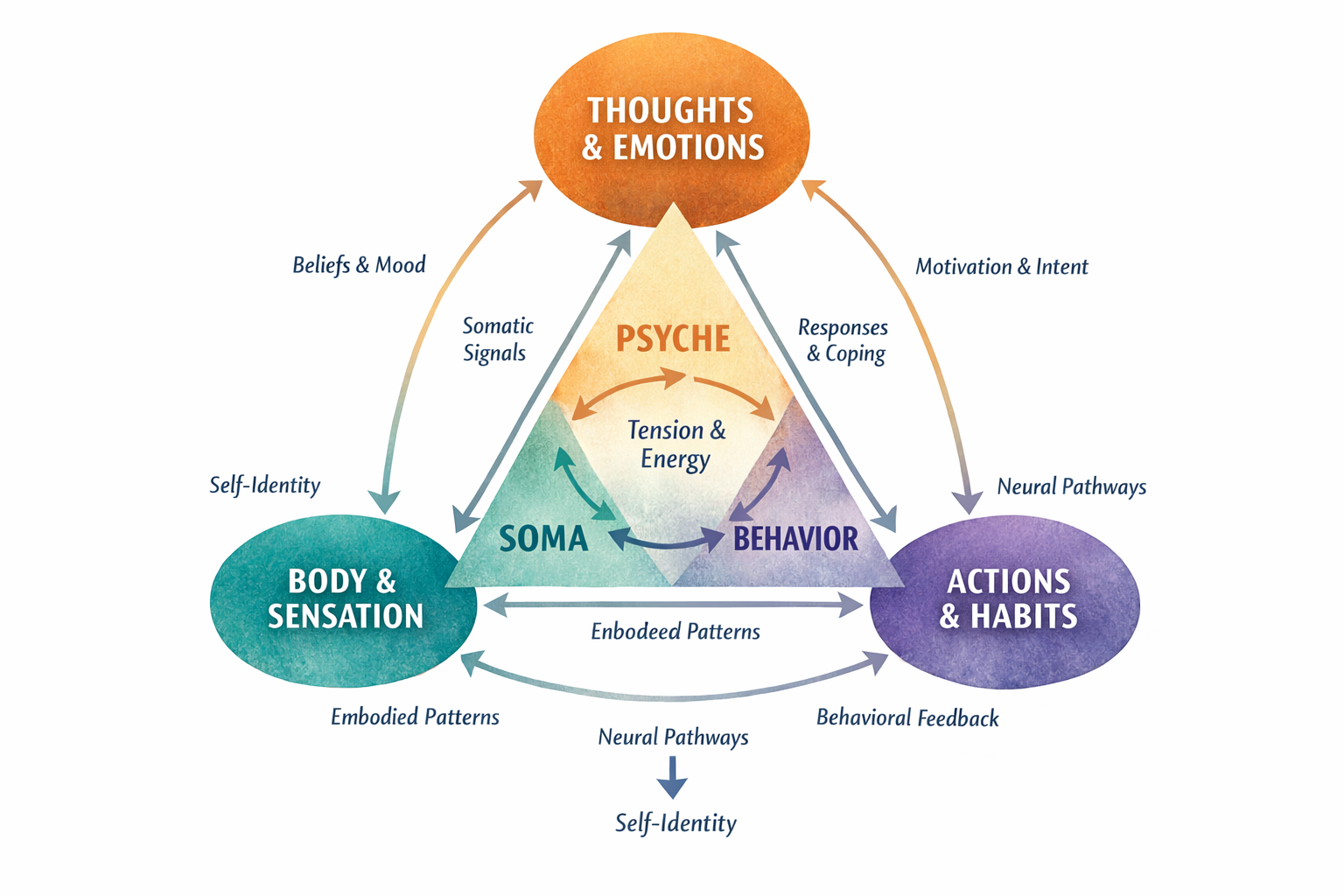
A model of a stable self-identity: a self-reinforcing system of thoughts, feelings and actions. These patterns are manifest expressions of internal dynamics; psych, soma (sensations), behaviour.
This bodywork approach works from the level of embodied sensation, breaking down the armouring around emotional wounds and blocks, breaking down these patterns that are held in the body, and allowing sensations to change (eg tensions or pain that felt permenant just dissolve and disappear).
The client also consciously participates in the process. As the process is slow, senstive and responsive to tensions held in the body and assocated sensations, clients find it deeply meditative. During the session, the clients find themselves descend from the mind, and immerses in the somatic experience. Yet, clients remain present, encouraged to observe sensations in the body, and later observe changes in sensations in the body. Clients are conscious whilst they experience tensions dissolve, sensations change, and stuck energy move, helping reframe our psychological and dysfunctional relationship with sensation.
This dysfunctional relationship is held structurally within the body, through patterns of tensions, and reinforced by the mind, through patterns of thoughts and beliefs, and behaviours through projection and reaction. Together, these become habitual and self-reinforcing patterns of behaviour, which all form part of an established sense of self.
These embodied sensations, bodily tensions, behaviours, and reactions are a foundational, underlying source of embodied trauma, a system of maladaptive psychological, emotional and behavioural patterns.